




Leading Policymakers and Scholars Convene in Beijing to Address a Changing Global Order
Jul 31-2026
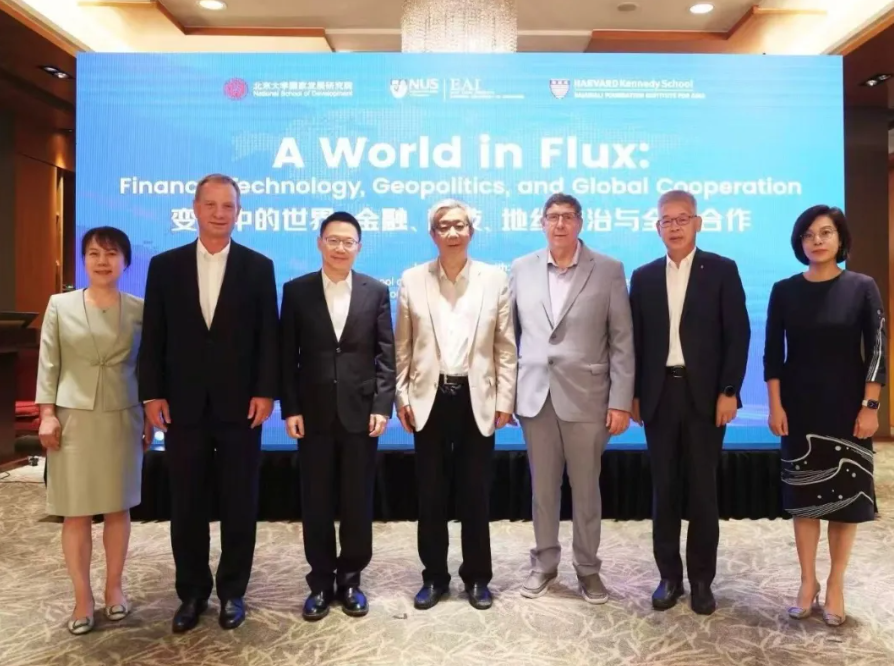 (left to right): Prof. Lei Xiaoyan, Secretary of the Party Committee and Professor of Economics at the National School of Development, Peking University; Prof. Alfred Schipke, Director of the East Asian Institute, National University of Singapore; Mr. Liao Min, Vice Minister of Finance of the People's Republic of China; Dr. Yi Gang, President of the Chinese Finance Society; Prof. Anthony Saich, Director of the Ash Center for Democratic Governance and Innovation, Harvard Kennedy School; Prof. Huang Yiping, Dean of the National School of Development, Peking University; and Prof. Zhang Dandan, Professor of Economics and Vice Dean of the National School of Development, Peking University.
Beijing, July 22, 2026 —
Amid escalating geopolitical tensions, rapid technological change, and growing economic fragmentation, senior policymakers, leading scholars, and international experts from the United States, Europe, and Asia gathered in Beijing to explore pragmatic policy responses and strengthen international dialogue.
The two-day conference, titled "Navigating Financial Transformation and Reforming Global Governance," was co-hosted by the East Asian Institute at the National University of Singapore, the National School of Development at Peking University, and the Rajawali Foundation Asia Institute at Harvard Kennedy School.
The conference sought not merely to analyze today's challenges but to put forward practical, implementable policy proposals for the profound shifts now reshaping the global economy. Discussions centered on the future of the international economic order, technological development and artificial intelligence, trade and supply-chain resilience, energy security, critical resources, and the role of international cooperation in an increasingly uncertain world.
On July 21, ahead of the conference, the co-hosting institutions held a welcome dinner featuring a keynote address by Mr. Liao Min, Vice Minister of Finance of the People's Republic of China. In his remarks, Vice Minister Liao outlined the essence of China's high-quality development and underscored the importance of sustained dialogue and cooperation in a period defined by uncertainty.
This Beijing gathering is the third in a series of joint conferences organized by the three institutions, following earlier meetings held in Singapore in January 2025 and at Harvard Kennedy School in Boston, United States, in December 2025. The series has become a trusted platform for candid exchange among policymakers and scholars committed to crafting practical, evidence-based solutions to shared global challenges.
Prof. Alfred Schipke, Director, East Asian Institute, National University of Singapore"The speed and scale of global change are testing our ability to respond effectively. In moments like these, sustained dialogue is not a luxury—it is a necessity. By bringing together policymakers and scholars from Asia, the United States, and Europe, we aim not only to identify problems but to put forward actionable, workable policy solutions that strengthen cooperation and resilience."
Prof. Huang Yiping, Dean, National School of Development, Peking University"Many of today's economic and technological challenges transcend national borders. Constructive dialogue grounded in rigorous research is essential for identifying shared interests and shaping policies that support long-term prosperity and stability."
Prof. Anthony Saich, Director, Rajawali Foundation Asia Institute, Harvard Kennedy School"Academic institutions play a vital role in creating trusted spaces for discussion—spaces where thorny issues can be openly debated and where empirical research can inform policymaking. At a time when international cooperation is needed most, this collaboration demonstrates the value of sustained engagement across borders."
The conference was co-organized by the Lee Kuan Yew School of Public Policy at the National University of Singapore and the School of Economics and Management at Tsinghua University.
About the Collaboration
This conference is part of an ongoing partnership among the East Asian Institute at the National University of Singapore, the National School of Development at Peking University, and the Rajawali Foundation Asia Institute at Harvard Kennedy School. Beyond the joint conference series, the collaboration encompasses joint research, policy publications, seminars, and academic exchanges—all aimed at promoting evidence-based policymaking and constructive international dialogue.