

News Center


BiMBA Wins 2026 Leading Brand in AI-Empowered Management Education

Nov 27-2026   


On 12 November 2026, the 2026 China University Business School Development Forum and Professional Degree Education Grand Ceremony opened in Beijing. BiMBA Business School of the National School of Development at Peking University was named a 2026 Leading Brand in AI-Empowered Management Education, in recognition of its systematic exploration and benchmark practice in bringing artificial intelligence into business education.

The Honours Roll

The Moment of Honor · 2026 Brand Tribute List carries six annual honours, spanning the building of technology-focused business schools, overall institutional influence, AI-empowered management education, the practice of integrating AI with business, high-quality business education, and innovative MBA programmes for future industrial ecosystems.
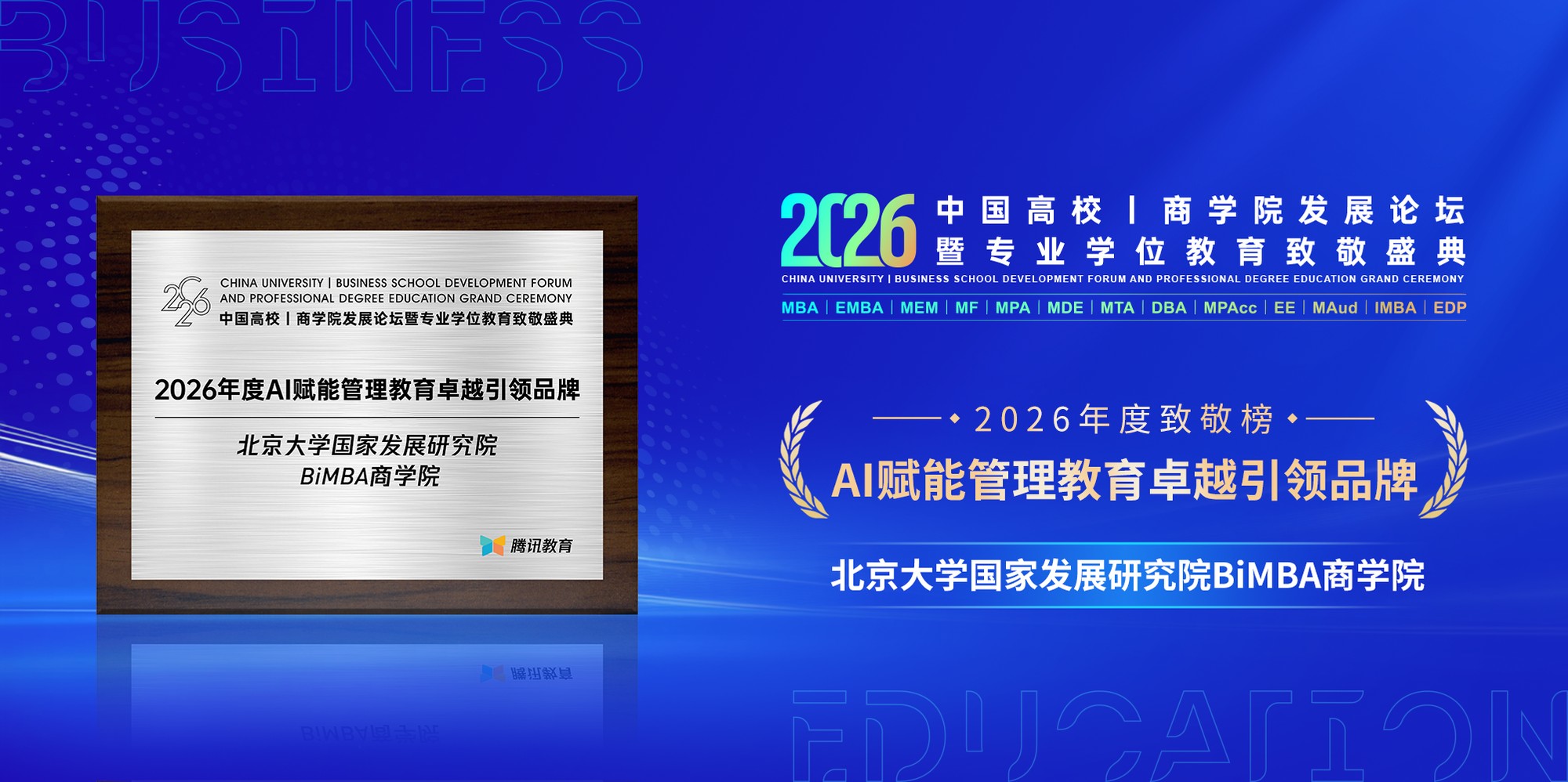
The AI award itself goes to schools that are opening up new ways to develop management talent in the AI era, that lead industry change through teaching innovation, and that have set a benchmark for AI in business education. In the sector’s eyes, it confirms both how early BiMBA laid its plans and how much those plans have actually delivered.

What This Round of AI Advancement Really Changes

Huang Zhuo, Professor and Vice Dean of PKU NSD and Dean of BiMBA Business School, was invited to address the forum on “AI Literacy Education for Entrepreneurs and Managers”. Drawing on the school’s own build-out, he set out what business education is for in the AI era, and what it is up against.

His argument was that this round of AI changes something larger than any single tool: it changes the business paradigm. AI has moved from chatbot to working partner, and now to agents that step into complex processes; human-machine collaboration has become the default way work gets done. The real challenge, he said, lies not in the technology but in whether entrepreneurs and managers can understand it and command it — which lands the question back on the classic business-school territory of organisation, strategy and people.

What the School Has Done

PKU NSD has been working the problem systematically. In 2024 it launched the AI+ Disciplinary Innovation Initiative, asking how AI might remake the research paradigms of economics, finance and management. In June of that year the Entrepreneur AI Voyage Program, a non-degree executive programme, opened for enrolment; after three rounds of refinement under a “practise for real, iterate fast” approach, the curriculum has settled into a clear structure and a practice-first body of knowledge. In 2026 the school introduced a 4+2+2 AI literacy framework across its EMBA, MBA and DBA programmes — completing an ecosystem that runs from theory through case discussion to application on the ground.

Teaching, case research, community and ecosystem-building then combine into a single lifelong learning platform. Its purpose is straightforward: to help entrepreneurs and managers take hold of change rather than be taken by it, and to convert uncertainty into sustainable competitive advantage.

“Hold to the foundations of education, turn toward what is new in technology and industry, and lay the ground for how China trains its managers.”

That charge, Huang Zhuo said, is what the forum’s own theme — Hold Fast, Turn to the New: Self-Reliance in Science and Technology — asks of everyone in the room. It is also where BiMBA will keep putting its weight as it reforms business education for the AI era.

Looking Ahead

The school intends to stay rooted in management practice as it is actually done in China, to advance cross-disciplinary work at a measured pace, and to deepen the collaboration between technology and business education — answering the questions of the age with management education of a high standard, and turning out more entrepreneurs and managers who can understand technology, steer change and lead.

The forum was hosted by Tencent Education and brought together more than 150 scholars and experts from over 80 Chinese universities to examine how the country’s business education is being remade, and where its innovations are pointing.


BiMBA Wins 2026 Leading Brand in AI-Empowered Management Education

Nov 27-2026   


On 12 November 2026, the 2026 China University Business School Development Forum and Professional Degree Education Grand Ceremony opened in Beijing. BiMBA Business School of the National School of Development at Peking University was named a 2026 Leading Brand in AI-Empowered Management Education, in recognition of its systematic exploration and benchmark practice in bringing artificial intelligence into business education.

The Honours Roll

The Moment of Honor · 2026 Brand Tribute List carries six annual honours, spanning the building of technology-focused business schools, overall institutional influence, AI-empowered management education, the practice of integrating AI with business, high-quality business education, and innovative MBA programmes for future industrial ecosystems.

The AI award itself goes to schools that are opening up new ways to develop management talent in the AI era, that lead industry change through teaching innovation, and that have set a benchmark for AI in business education. In the sector’s eyes, it confirms both how early BiMBA laid its plans and how much those plans have actually delivered.

What This Round of AI Advancement Really Changes

Huang Zhuo, Professor and Vice Dean of PKU NSD and Dean of BiMBA Business School, was invited to address the forum on “AI Literacy Education for Entrepreneurs and Managers”. Drawing on the school’s own build-out, he set out what business education is for in the AI era, and what it is up against.

His argument was that this round of AI changes something larger than any single tool: it changes the business paradigm. AI has moved from chatbot to working partner, and now to agents that step into complex processes; human-machine collaboration has become the default way work gets done. The real challenge, he said, lies not in the technology but in whether entrepreneurs and managers can understand it and command it — which lands the question back on the classic business-school territory of organisation, strategy and people.

What the School Has Done

PKU NSD has been working the problem systematically. In 2024 it launched the AI+ Disciplinary Innovation Initiative, asking how AI might remake the research paradigms of economics, finance and management. In June of that year the Entrepreneur AI Voyage Program, a non-degree executive programme, opened for enrolment; after three rounds of refinement under a “practise for real, iterate fast” approach, the curriculum has settled into a clear structure and a practice-first body of knowledge. In 2026 the school introduced a 4+2+2 AI literacy framework across its EMBA, MBA and DBA programmes — completing an ecosystem that runs from theory through case discussion to application on the ground.

Teaching, case research, community and ecosystem-building then combine into a single lifelong learning platform. Its purpose is straightforward: to help entrepreneurs and managers take hold of change rather than be taken by it, and to convert uncertainty into sustainable competitive advantage.

“Hold to the foundations of education, turn toward what is new in technology and industry, and lay the ground for how China trains its managers.”

That charge, Huang Zhuo said, is what the forum’s own theme — Hold Fast, Turn to the New: Self-Reliance in Science and Technology — asks of everyone in the room. It is also where BiMBA will keep putting its weight as it reforms business education for the AI era.

Looking Ahead

The school intends to stay rooted in management practice as it is actually done in China, to advance cross-disciplinary work at a measured pace, and to deepen the collaboration between technology and business education — answering the questions of the age with management education of a high standard, and turning out more entrepreneurs and managers who can understand technology, steer change and lead.

The forum was hosted by Tencent Education and brought together more than 150 scholars and experts from over 80 Chinese universities to examine how the country’s business education is being remade, and where its innovations are pointing.