



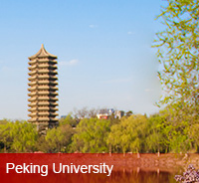


On 18 November 2026, a senior delegation from Merck KGaA, Darmstadt, Germany, led by Khadija Ben Hammada — Member of the Executive Board and Chief People Officer — visited the National School of Development at Peking University (PKU NSD). The visitors toured the Chengze Garden campus and sat down with the school’s leadership and faculty. The two sides reviewed seventeen years of cooperation and exchanged views on talent development in the age of AI, leadership, family succession, and how a multinational company can make sense of China. They reached agreement on deepening a long-term partnership.

The Two Delegations
Representing PKU NSD were Huang Yiping, Dean of the National School of Development; Huang Zhuo, Vice Dean of NSD and Dean of BiMBA Business School; Yang Zhuang, former Co-Dean of BiMBA Business School; Li Lixing, Professor of Economics; Zhang Xiaomin, Assistant Dean of NSD and Director of the Corporate Training Department; and Wang Xin, Assistant Dean of BiMBA Business School and Director of Corporate Relations.
Representing Merck were Khadija Ben Hammada, Member of the Executive Board and Chief People Officer; Wang Yong, Head of Human Resources and Head of Legal and Compliance, Merck China; He Siya, Chief Financial Officer, Asia Pacific; Ma Li, Head of Corporate Communications, Merck China; Mu Youran, Head of the Office of the Chief People Officer; and Li Siqi, Employee Relations Partner, Asia Pacific.

A Partnership of Seventeen Years
Founded in 1668 and now 358 years old, Merck is a global leader in healthcare, life science and electronics. Its cooperation with the school dates to 2009. Custom programmes designed by NSD for Merck have since trained more than 400 senior and mid-level managers, and Merck has funded both a dedicated classroom and an MBA scholarship.
During the roundtable, the school’s leadership briefed the Merck executives on where NSD stands today. The school is at once a research institution, a think tank, a business school and the home of the Institute of South-South Cooperation and Development. Drawing on the country’s needs and on its own identity as a think tank, it has set out the research directions it intends to pursue in the years ahead.

Dean Huang Yiping noted that Merck has kept investing in China — and that each year has gone better than the last. Its experience, he said, is worth spreading. On behalf of the school he thanked Merck for its sustained support, and said he hoped the two sides would go further together.

Huang Zhuo, Vice Dean of NSD and Dean of BiMBA Business School, began with the school’s culture of “harmony without uniformity”, which puts competing views on the same stage. That kind of disciplined argument, he said, is a core part of executive education. Facing the arrival of the AI era, NSD has made AI a major research focus and has launched the Entrepreneur AI Voyage Program, designed to help founders and senior executives embrace AI and get their intelligent transformation right. Its executive courses, he added, are shifting from the transmission of knowledge towards the building of judgement frameworks. He said he would like to see the partnership move beyond single programmes into a long-term mechanism: co-designed curricula, joint research, and the exchange of people.

Yang Zhuang, former Co-Dean of BiMBA Business School and a specialist in cross-cultural leadership, taught in the Merck programme for many years. Many multinationals cut their training budgets at the first sign of pressure, he observed; Merck has not. Merck has also carried its family-business values into the classroom intact. China’s first generation of founders is now handing over, and Merck’s experience offers them a reference point. As for Chinese companies going global, their weak spot is a thin understanding of local markets — and Merck’s habit of bringing headquarters decision-makers to China first, and only then talking about China, is a practice worth copying.

Khadija Ben Hammada said the Chinese market matters enormously to Merck, and put the point sharply:
“If you are making decisions in China, you cannot do it with an incomplete picture of China.”
Merck, she said, needs to study business cases, and it also wants to stay close to academia — to put scholars’ insights and research findings to work in commercial practice. The company currently sends a large number of Chinese staff to headquarters and continues to take talent development as seriously as it ever has. She hoped to go deeper with PKU NSD on leadership development and on research into the Chinese market.
What Comes Next
Both sides said their future cooperation would centre on AI and industrial change:
Co-build leadership courses for the AI era, and use them to develop management teams.
Turn Merck’s commercial successes and its three centuries of family heritage into teaching material.
Make exchange between industry and academia a standing arrangement rather than an occasional event.
Draw on the Institute of South-South Cooperation and Development’s network to explore talent development, industrial cooperation and philanthropic empowerment for markets across the Global South.

At the close of the event, Dean Huang Yiping presented Ms Ben Hammada with The Digital Financial Revolution in China, the English-language volume he co-edited with David Dollar, in the hope that Merck’s executives would come away with a fuller picture of the transformation under way in Chinese finance.

The event was organised by NSD’s Corporate Relations Department.