




AI & Going Global: The Second Curve of Enterprise Growth
Jul 24-2026
2026 NSD Automotive Industry Association Brand Week Successfully Concluded
From July 6 to 12, 2026, the "2026 NSD Automotive Industry Association Brand Week" — a series of events hosted by the Automotive Industry Association of the National School of Development (NSD) at Peking University — was successfully held.
This year's Brand Week adopted an innovative "2+1" matrix format: two online livestream sessions focused on AI and going global, plus one in-person sharing session held at Chengze Garden on the PKU campus. Themed "AI, Going Global, and the Second Growth Curve of Enterprises," the series brought together experts and outstanding alumni from academia, macroeconomics, the automotive industry, and the technology frontier to analyze the structural transformation sweeping China's auto industry and explore pathways to breakthrough via AI-driven restructuring and global expansion.
Online Sessions: A Clash of Ideas
The Dual Engine of AI and Going Global
July 6 Livestream |
AI Is Not a Layoff Tool — It's a New Engine for Growth
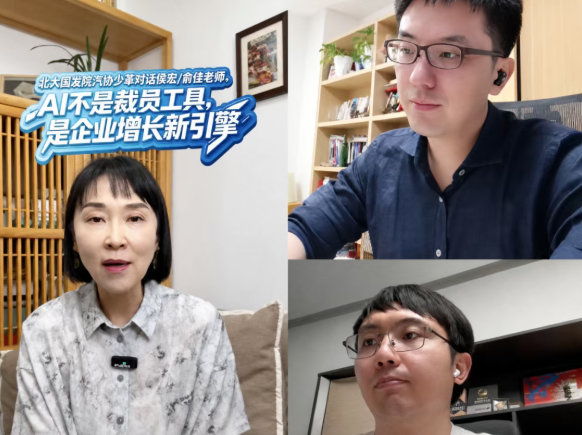
Left: Wu Shaoge; Top right: Hou Hong; Bottom right: Yu Jia
In the opening livestream, Wu Shaoge — Vice President of the NSD Automotive Industry Association and a 2008 EMBA alumna — served as host. She was joined by Hou Hong, Assistant Professor of Management at NSD, and Yu Jia, Co-founder and President of Xihu Xincheng (Westlake Mind), for an in-depth dialogue on how AI is reshaping organizational structures.
Drawing on his entrepreneurial experience, Yu Jia noted that AI has dramatically shortened the boundaries between different roles — young employees can now independently handle the entire workflow from product design to development and launch. But he was emphatic: "AI is not a layoff tool. Companies still need organizations to provide legal, algorithmic, and growth-related support to achieve real business outcomes."
Professor Hou Hong dismantled the misconception of "AI replacing humans" from an organizational management perspective. He pointed out that many people think of organizations as machines, where parts can simply be swapped out for AI. In reality, an organization is a living organism. What makes human beings most valuable is "double-loop learning" — machines can only optimize efficiency toward a given goal, while humans can question and redefine the goal itself. Professor Hou urged business leaders to embrace AI transformation with a "growth mindset" rather than a defensive "cost-cutting" mentality.
July 8 Livestream |
The Trust Dividend: The Underlying Logic of Chinese Enterprises Going to Africa
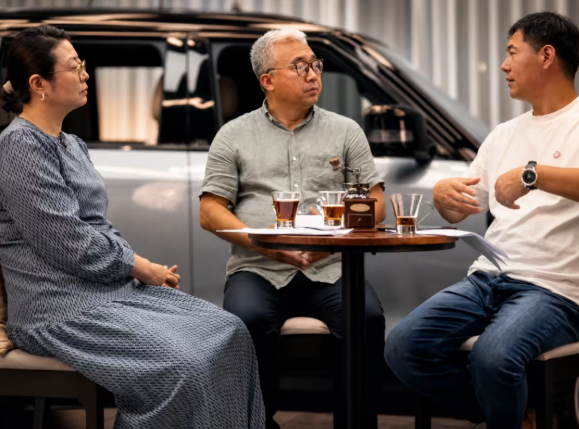
Left: Wang Jinjie; Center: Xue Guang; Right: Liu Hui
The second livestream was hosted by Liu Hui — CEO of Chelinzi, President of the NSD Automotive Industry Association, and a 2011 EMBA alumnus. He was joined by Wang Jinjie, Researcher at the Asia-Africa Studies Division of PKU's Institute of Area Studies and Deputy Director of PKU's Center for African Studies, and Xue Guang — a seasoned entrepreneur with 13 years of deep experience in Africa, Chairman of East Africa's Jie Shi Group, and a 2025 EMBA alumnus — to paint an authentic picture of expanding into the African market.
Wang Jinjie pointed out that as African countries accelerate industrialization, Chinese enterprises' expansion into Africa has evolved from early-stage infrastructure projects to a new wave led by private enterprises in the "new trio" sectors. Drawing on firsthand observations from Ethiopia, Xue Guang added that geopolitical shifts and energy crises have fueled explosive demand for green energy and new energy vehicles across the continent. Ethiopia, for instance, began restricting fuel-vehicle imports in 2024 while fully opening up to new energy vehicles — presenting a tremendous opportunity for Chinese automakers.
On the challenges of going global, the panelists reached a consensus: enterprises must "walk on two legs." One leg is the equitable distribution of commercial interests — companies must build and share value together with local communities. The other leg is establishing "trust" — not merely interpersonal trust, but deep integration with local culture and government.
In-Person Session: "Chengze Wisdom" on Industry Restructuring and Breakthroughs
After two livestreams laid the intellectual groundwork, the final event of Brand Week — an in-person sharing session — took place on the afternoon of July 12 at Chengze Garden, PKU.

Wu Shaoge
Vice President, NSD Automotive Industry Association
2008 EMBA Alumna, NSD
Wu Shaoge hosted the session, introducing the origins of Brand Week. She noted that the automotive industry currently stands at the intersection of multiple transformations: AI is comprehensively reshaping the entire value chain from production to R&D to services; Chinese automakers' global expansion is evolving from product export to systematic global operations; and with global supply chains, trade, and energy environments in constant flux, how enterprises can break through growth bottlenecks and build a sustainable second curve has become a core strategic question that every industry professional and entrepreneur must confront.
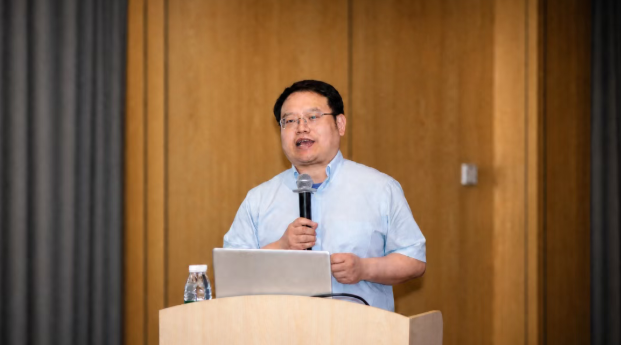
Huang Zhuo
Professor, National School of Development, Peking University
Vice Dean, NSD
Lead Professor, NSD "Entrepreneur AI Launch Program"
Professor Huang Zhuo, Vice Dean of NSD, delivered the opening remarks. He pointed out that the automotive industry is currently the most representative and dynamic embodiment of China's "new quality productive forces." NSD not only conducts deep academic research but has also cultivated a large number of leading talents in pillar industries such as automotive. Amid the dual waves of AI and globalization, NSD will continue to leverage its strengths as a think tank and platform, empowering alumni enterprises to find their "second curve" amid restructuring.
Guest Presentations

Xu Changming
Senior Economist, State Information Center
Leading Automotive Industry Analyst, China
2012 EMBA Alumnus, NSD
Xu Changming delivered an in-depth presentation titled "Structural Changes and Opportunities in the Automotive Industry During the 15th Five-Year Plan Period."
Xu noted that while domestic vehicle insurance registrations declined year-over-year in the first half of 2026 and competition in the stock market is exceptionally fierce, a positive perspective reveals that China's auto industry is undergoing a magnificent "structural breakthrough."
In overseas markets, Chinese automobiles are demonstrating remarkably strong growth momentum. Full-year exports are projected to exceed 10 million units, with 5.1 million already shipped in the first half of the year. Even more encouraging, electric passenger vehicle exports historically surpassed fuel vehicles for the first time in the first half of this year — compelling evidence that China's EVs have achieved a qualitative leap in global competitiveness. By region, exports to Europe grew 82% year-over-year, South America 118%, Africa 114%, and Russia 138%. This multi-point bloom across emerging markets is providing Chinese automakers with vast room for growth.

Wen Yifei
Renowned Financial Author
Founder of the self-media channel "Wen Yifei's Emergency Finance"
Wen Yifei delivered a keynote titled "The Four Quadrants of China's Economy: How AI and Going Global Are Reshaping Industrial Structure and Long-Term Development." He creatively proposed a "Four Quadrants of China's Economy" model, using "globalization capability" as the horizontal axis and "AI capability" as the vertical axis, redefining the survival lines for today's enterprises.
Through macro data, Wen pointed out that China's trade surplus has historically reached $1 trillion, with foreign trade contributing one-third of China's GDP growth. The head effect of the Chinese economy is amplifying to an extreme degree.
Wen also incisively highlighted a profound "mismatch between growth and employment" in the current Chinese economy. Emerging core industries in the first quadrant (possessing both AI and globalization capabilities) contribute over 60% of economic growth, yet these highly capital- and technology-intensive industries employ less than 10% of the urban workforce. In an environment of cutthroat competition and industry consolidation, enterprises lacking AI and globalization capabilities will face enormous challenges. For traditional enterprises to survive, they must actively migrate toward the first quadrant. The automotive industry, as the vanguard of new quality productive forces, must globalize to spill capacity and value outward while using AI to restructure internal efficiency.

Gao Rui
Vice President, Memsen Semiconductor (Tianjin) Co., Ltd.
2017 EMBA Alumnus, NSD
As the outstanding alumni enterprise representative at the in-person session, Gao Rui delivered a presentation titled "Sensing Everything, Boundless Future: Embracing the Globe and Riding the AI Wave." Gao argued: "For future smart vehicles and embodied robots, the core competitive moat will undoubtedly be 'smart chassis + full-domain perception + autonomous supply chain.' In an era of highly homogenized hardware solutions, chassis control and perception precision will create the decisive gap."
With nearly 30 years of deep expertise in sensing technology, Memsen Semiconductor has been a reliable partner to global automotive Tier 1 suppliers for over 25 years and is currently the only domestic manufacturer in the automotive acceleration sensor space. At the event, Gao proudly announced: "Memsen has invested six years and RMB 700 million to successfully develop our own six-axis IMU (Inertial Measurement Unit) — completely breaking the long-standing monopoly of well-known foreign brands and overcoming a critical technology bottleneck for domestic industry." This hardcore product provides smart vehicles with high-precision, low-noise, and highly stable attitude data — a core component for smart chassis and inertial navigation.
Panel Discussion
A Deep Dive: The Second Curve × AI Restructuring × Supply Chain Dynamics

From left to right: Ren Hao, Wen Yifei, Huang Zhuo, Pang Yicheng, Chen Qiang
In the panel discussion that followed, Ren Hao — CEO of Beijing Youche Lian Technology and a 2014 EMBA alumnus — served as moderator. He was joined by Professor Huang Zhuo, Vice Dean of NSD; Wen Yifei, renowned financial author; Pang Yicheng, CEO of D1EV and a 2008 EMBA alumnus; and Dr. Chen Qiang, an autonomous driving expert leading VLA large model R&D and deployment. The panelists engaged in a vigorous two-hour exchange of ideas.
Topic 1
The Ultimate Verdict on Physical AI and the "Reconnaissance" of Tech Giants
On the intersection of AI and automotive, Pang Yicheng, CEO of D1EV, offered a forward-looking judgment: "This is a reconstruction of the human world by physical AI, and cars and smartphones are the two most core and massive entry points." Pang pointed out that the physical AI ecosystem is only just beginning to take shape. In the future, not only existing automakers but also many potential top-tier tech giants will enter the space in a "reconnaissance" posture — deeply integrating software, large models, and even hardware to close the ecosystem loop.
Discussing the competitive landscape of autonomous driving, Dr. Chen Qiang observed that the physical AI reconstruction of the world has only just begun and is far from a "winner-takes-all" stage. In this vast ecosystem, the "ecological niche" an enterprise can occupy is fundamentally determined by its underlying DNA. As technology competition enters deeper waters, what truly matters is "talent density" and a culture that embraces bold experimentation. Only organizations with free-flowing idea exchange and strong fault-tolerance mechanisms can attract the best talent and emerge victorious from fierce competition.
Wen Yifei offered a sharp economic perspective: the employment impact of AI is a global challenge that the market alone cannot fully resolve — this is a classic case of market failure. However, China possesses a unique institutional advantage: the government's powerful capacity for resource mobilization can effectively buffer the impact of AI disruption. Wen believes AI is accelerating a shift from "investing in things" to "investing in people" — which is inherently a good thing, marking a historic return to a people-centered approach to economic development.
It was Wen Yifei who first raised this sharp industry pain point, pushing the discussion to its most intense depths: the moment news broke that a certain automaker was developing its own chips, the stock price of its Tier 1 supplier plummeted. Moderator Ren Hao pressed the question pointedly: Will this dynamic devolve into a life-or-death battle, or will it eventually reach some form of equilibrium? Will automakers cooperate with suppliers today only to turn them into competitors tomorrow?
Dr. Chen Qiang noted that the contest between automakers and autonomous driving/chip companies is inevitable — it is fundamentally a struggle over data sovereignty and profit margins. However, as technology competition deepens, victory will be determined by two underlying factors: talent density and full-lifecycle supply chain security. Automotive-grade chips and autonomous driving solutions cannot compete on extreme specs alone — reliability and stability are paramount. There are limits to in-house development by automakers. Professional Tier 1 perception and chip companies, backed by IDM semiconductor processes and exceptional yield control, still possess irreplaceable professional moats. The two sides will ultimately evolve toward a deep, dynamic coexistence through fierce competition.
Topic 2
The "Cultural Migration" Beneath the Technology Revolution: Maybach vs. the New Chinese Aesthetic
Discussing the impact of smart vehicles on traditional luxury brands, Professor Huang Zhuo offered a deeply humanistic observation: in the ultra-luxury market above the million-yuan level, what consumers purchase is often not mere "functionality," but social identity and cultural faith. Young nouveaux riches will still buy Maybachs and Porsches because they aspire to join long-established circles of prestige. This is where the source of human culture lies — it requires a long time to be transmitted and accumulated, and cannot be dismantled by technology in the short term. But Professor Huang also noted that technology is immensely powerful; it will inevitably attract culture to its side because it touches the essence. Sooner or later, the younger generation will grow up, they will become the new decision-makers, and the rules will be rewritten.
Wen Yifei strongly agreed, citing a vivid economic case: the Pearl River Delta is the most economically active and affluent region in China, yet its luxury goods purchases are not the highest in the country. This precisely demonstrates that a "New Chinese Aesthetic" cultural migration is quietly underway — people no longer need to signal their status through the purchase of foreign luxury goods; domestic high-tech luxury is becoming the new symbol of cultural identity. Wen believes this cultural migration is not being forced by technology but is a natural awakening of cultural confidence that comes with economic development to a certain stage. As the generation that grew up with smart cabins and advanced autonomous driving gradually takes the reins of society, the cultural narrative of China's automotive industry will be fundamentally rewritten.
Acknowledgments
Co-Sponsors
-
Memsen Semiconductor (Tianjin) Co., Ltd.
-
Hangzhou Wuwo Wujin Information Technology Co., Ltd.
Media Partners
-
Xinhua Auto
-
Phoenix Auto
-
EO (yiyiou.com)
About the PKU NSD Automotive Industry Association
The PKU NSD Automotive Industry Association is a professional organization within the school focused on the automotive industry. Co-founded by NSD EMBA and MBA alumni working in the automotive sector, it was officially established on August 24, 2024. The association aims to build a warm community for exchange and resource sharing among faculty, students, and alumni interested in the automotive industry, serve as an influential platform bridging industry, academia, and research, and support the continuous innovation and development of the automotive industry.
The association upholds five core values:
-
Warmth and community
-
Starting small and dedicating consistently
-
Openness and transparency
-
Long-termism
-
Lifelong learning